" Psyche in Hell " by Eugene Ernest Hillemacher


"Psyche in Hell" by Eugene Ernest Hillemacher


 The painting Psyche aux enfers was donated to the Melbourne gallery by Esq. Gustave Coursier in 1872. Its author is the French academic artist, master of historical, portrait and genre painting Eugène-Ernest Hillemacher (1818 - 1887). The plot is based on an episode of the legend of the eternal love of Cupid and Psyche.


 Psyche was a mere mortal with a difficult fate: she was strikingly beautiful, her body was perfect. People worshiped her, evil sisters envied her, and men did not try to get the hand of a beauty - she was too good, like a goddess. Aphrodite was offended that the beautiful Psyche was compared with her, and asked her son Cupid to make the girl fall in love with a terrible monster. However, the god of love was fascinated by the beauty of Psyche and did not fulfill his mother's order: instead, he decided to fall in love with the beauty in himself.


 Then Cupid's mother orders Psyche to undergo a series of trials.

 First, Psyche had to sort out a huge pile of grain. The ant colony helped her complete the task.


 Then Aphrodite sent her for the golden fleece of a ferocious ram, which killed quite a few people. The river god helped the beauty: he told how to collect fleece wool that clung to thorny bushes.


  Finally, the goddess sent Psyche to the realm of the dead for a box of beauty from Persephone. The girl appeased Cerberus with pies, and Charon with coins. She completed the task and hurried to Aphrodite. Psyche should not open the box along the way, but after reaching her goal, curiosity gets the best of her, and she looks in, but there was not beauty, but an eternal dream that overcame the girl. But Cupid saved her! The God of love gave Psyche ambrosia to drink and made her immortal. Since then, the happy couple lived in peace and harmony.


"Psyche in Hell" by Eugene Ernest Hillemacher   1825 Oil on canvas. Size: 117 × 90 cm. National Gallery of Victoria, Melbourne

 "Psyche in Hell" by Eugene Ernest Hillemacher

 1825 Oil on canvas. Size: 117 × 90 cm. National Gallery of Victoria, Melbourne


Anthony Frederick Augustus Sandys ( 1829 - 1904) | A 18th Century Pre-raPhaelite English Painter | ArtLiveAndBeauty


Anthony Frederick Augustus Sandys's Paintings


Anthony Frederick Augustus Sandys, or just Frederick Sandys (May 1, 1829 - June 25, 1904) -On May 1, 1829, in Norija, Norfolk, England, an English painter Pre-Raphaelite, an illustrator and a drawingman who authored mostly portraits, as well as works in the area of mythical painting, was born. His father, who was also an artist, gave him his first drawing lessons. Frederick Sandys, who shown exceptional talent, attended the Noridge designer school (English Norwich School of Design) in 1846 on the recommendation of his father, and rose to prominence owing to his caricature of the Nightnaya Nightmare for John Evetta Mille Sir Izuyumbra in 1857. 


Artist Hugues Merle (1823–1881) | 19th Century Gerne Painter | ArtLiveAndBeauty


Artist Hugues Merle's Paintings

Hugues Merle (1823–1881) was a 19th-century well-known as a portrait and genre scene French painter , Hugues Merle was born at La Saune in 1822. Léon Cognier was his painting teacher. Second-degree awards were awarded. In 1866, the artist was appointed a Chevalier of the Legion of Honor. Hugh Merle was Paul Durand-acquaintance Ruel's in the early 1860s. Durand-Ruel began purchasing Merle works in 1862 and introduced the artist to William-Adolphe Bouguereau. Merle was frequently compared to Bouguereau later in his career, and he "become a real rival to Bouguereau in narrative and treatment." Merle created many portraits of Paul Durand-Ruel, his wife, and their son John in the mid-1860s.

Hugues Merle Paintings

Artist Jean - Etienne Liotard 🇨🇭 (1702-1789) | ArtLiveAndBeauty


Jean Etienne Liotard's Paintings


Jean - Etienne Liotard (1702-1789), a Swiss artist, was born in Geneva in 1702 as the thirteenth child of Anne and Antoine Lyotard. His parents, both Protestants, moved from France to Switzerland before his birth for religious reasons. In Geneva, owing to the jewellery trade, his father began to prosper and was able to offer a good education for his children. It should also be mentioned that according to some accounts, Jean-Etienne had a twin brother - Jean-Michel, or possibly just an older brother - who also became an artist but did not achieve the same level of fame. Painters use pastels for a variety of technical reasons. However, there was a virtuoso artist in the history of painting in whose hands the pastel seemed to spring to life and become a lively and malleable visual medium. This artist's name is Jean-Etienne Lyotard, and he made his one-of-a-kind creations about 300 years ago. His pastel pictures continue to astound and enchant the audience to this day. And, presumably, that is why the whole European elite - from monarchs to first beauties and members of the enlightened intellect - waited in line for the artist.


34 Paintings of Artist Marguerite Gerard 🇫🇷 ( 1761 - 1837) | ArtLiveAndBeauty


Marguerite Gerard's Paintings


Marguerite Gerard ( 1761 - 1837) she was a French artist , she was a pupil of Honore Fragonard , miniaturist, and book graphic artist. Marguerite Gerard moved to Paris at the age of 16 from her birthplace of Grasse. There, she launched her career under the tutelage of her fellow countryman and her older sister's husband, the renowned artist Honore Fragonard. She first learns from her brother-in-law and subsequently works as his assistant. Fragonard aided and promoted his skilled protégé in every way he could. There were also speculations that the teacher and his student did not have a good working relationship. Whatever it was, Fragonard most likely collaborated on several works with Marguerite Gerard. Their artistry was impacted both practically and metaphorically by the smells of their hometown: Grasse is the French fragrance centre, where the Fragonard and Gerard families have passed down the secrets of delectable scents from generation to generation. Those who chose to become artists appeared to want to imbue their work with the sunlight of the south, creating a distinct taste for each piece.


" the cat lunch " Marguerite Gerard

" Allegory of War and Peace " 1776, By Artist Pompeo Girolamo Batoni (1708-1787) | ArtLiveAndBeauty


" Allegory of War and Peace " By Artist Pompeo Girolamo Batoni 


Pompeo Batoni (1708-1787) was a prominent and sought-after 18th-century Italian painter. The forefather of the ceremonial representative portrait in the classicism style. Representatives of this movement mostly painted mythical and religious subjects, viewing allegory as a "high" historical genre.

The 17th and 18th centuries were marked by a broad interest in allegory, deciphering meaning, and creating symbols. Allegory has become an intrinsic aspect of the works of the artist Pompeo Batoni's substance. Many aesthetic tendencies and period trends spontaneously combined in his work: echoes of the late baroque, light playful shapes of rococo, and trends of a new movement - neoclassicism.

The realistic inclinations of 18th-century Italian painting could not but but influence Batoni's art. Even in this regard, the artist's perspective remained ambiguous; frequently, the master's sympathies were represented in extremely disparate works.

In his painting "Allegory of War and Peace," he shows Mars, the god of battle, and a lovely half-naked girl, who represents peace. The artist refers to the narrative as having metaphorical elements, in which the concept of bravery, the triumph of duty, collides with human emotions - love and emotional bonds.


" Allegory of War and Peace " 1776, By Artist Pompeo Girolamo Batoni, Oil on canvas. 136 x 99 cm Art Institute of Chicago
 " Allegory of War and Peace " 1776, By Artist Pompeo Girolamo Batoni, Oil on canvas. 136 x 99 cm Art Institute of Chicago

" The Oath of the Horatii " , Jacques-Louis David (1748–1825) | ArtLiveAndBeauty


The Oath of the Horatii,  By Artist Jacques-Louis David  (1748–1825)


" The Oath of the Horatii " was a watershed moment not just in Jacques-Louis David's art, but in European painting as a whole. The artwork helped to birth a new style, founding the French neoclassicism school.


If the "feminine universe" with its curving lines dominated 18th-century painting, it was now giving way to the verticals of the "masculine world," emphasizing the prominent role of valor, heroism, and military service. David acquired recognition across Europe with this canvas.


"The Oath of the Horatii" exposes the terrible and irreconcilable tensions between civic obligation and personal sentiments of people. The narrative of the film is based on an ancient Roman legend. During Rome's conflict with Alba Longa, three Romans, brothers from the Horatii family, were forced to fight a death combat to determine the conclusion of the dispute between the warring towns. The Horatii's opponents are childhood buddies. One of them is in a relationship with the Horatii's sister. As they prepare for a fatal fight, the brothers swear a promise to their father to safeguard the fatherland. They are unwavering and steadfast in their lofty motivation, which is reinforced by the uniformity of vast dynamic motions. The achievement is blessed by the Father.


Friends discouraged Jacques-Louis David from pursuing this plan, which, in their judgment, did not fit the attitude of the moment. Jacques-Louis David said that he would chose the moment before the war when old Horace accepts an oath from his son to win or die - a moment that the artist could only guess at due to the lack of specifics.


Jacques-Louis David employed a number of classical approaches. The painting's backdrop is darkened, but the characters in the front are emphasized to emphasize their importance. Dull colors are employed to emphasize the importance of the tale being depicted above the painting itself. The number "three" and the triangle are represented by a clear and distinct composition. Clear features are preferred over the light strokes associated with Rococo. Only women display strong emotions, while men perform their duties.


The painting was submitted to the Paris Salon, and David was concerned that he would be put in an unfavorable position owing to the machinations of his haters. However, the concerns were baseless. "The Oath of the Horatii" was well appreciated by the general audience.


The painting is part of the Louis XVI collection and is now on display in the 75th chamber on the first floor of the Louvre's Denon Gallery.


The Oath of the Horatii,  Jacques-Louis David  (1748–1825)  1784 Oil on canvas. Size: 330 × 425 cm Louvre, Paris

" Time orders Old Age to destroy Beauty " By Artist Pompeo Batoni (1708-1787)


"Time orders Old Age to destroy Beauty", By Pompeo Batoni 


Bartolomeo Talenti, a Lucca nobleman who sponsored Batoni's early career in the 1740s, commissioned the painting.Time, Old Age, and Beauty are shown in the artwork.Time is a gray-haired old guy with white wings behind his back. He holds an hourglass in his hand as a metaphor of the transience of what he represents. Sand granules move inexorably from one part to another. Nothing is going to stop them. Nothing can stop the passage of time.The painting was completed in 1746. This is clearly revealed by the author's signature on the front of the painting. It is visible on the right side of the image. Hence the authorship and date of production are unquestionable. In 1798, the artwork was acquired by Russian prince Alexander Andreevich Bezborodko. His art collection was passed down to his great-grandchildren after his death. "Time commands old age to ruin beauty," it turned out, belonged to Nikolai Aleksandrovich Kushelev-Bezborodko, an avid collector. Upon his death, Kushelev's art collection was left to the Museum of the Academy of Arts, which established a separate Kushelev gallery (there were more than 500 paintings and sculptures in the gallery).

Regrettably, the artwork "Time commands old age to ruin beauty" is no longer available in Russia. It is now on display in the National Gallery in London. The museum purchased it in 1961.

Nothing has the ability to stop time. Even youth and attractiveness. A little girl represents Beauty in the painting. She is still stunning. Yet Time's harsh finger is already pointed at her. And nearby is an unattractive elderly woman who represents Old Age. And Old Age's hands are already reaching out to the young and budding face of Beauty. Because, no matter how much Beauty turns away, no matter how long it postpones the encounter with Old Age, it is unavoidable. Because the clock has struck twelve. Of course, this will not happen overnight. The tree behind the young maiden is still green and healthy. However, in time, only a dried twig of him will remain, which will be placed on the coffin, which is already visible behind the elderly woman. A painting that is both powerful and profound in its significance. Is she capable of making someone uninterested? It is, after all, about each of us. And it is up to us to determine what to do if old age, at the behest of time, destroys our beauty. And it certainly will be... Pompeo Girolamo Batoni (1708-1787) was a prominent and sought-after 18th-century Italian painter. Batoni aimed for the mild classicism of the past masters in his painting. And this artwork is representative of the artist's tastes.


"Time orders Old Age to destroy Beauty", By Pompeo Batoni ,c.1746. Canvas, oil. Size: 135 x 96cm. National Gallery, London
 "Time orders Old Age to destroy Beauty", By Pompeo Batoni ,c.1746. Canvas, oil. Size: 135 x 96cm. National Gallery, London


83 Paintings By Artist Élisabeth-Louise Vigée Le Brun | ArtLiveAndBeauty


Artist Élisabeth-Louise Vigée Le Brun


Elizabeth Vigee-Lebrun (Louise Élisabeth Vigée Le Brun), a beautiful and cautious careerist, was really adored by Queen Marie Antoinette and Empress Catherine II could not stand to disgust her. Why - this will become evident after reading the artist's biography.


Marie Elisabeth Louise Vigée-Lebrun was born in 1755 in the household of Louis Vigee, a bourgeois "lower classes" artist who was neither especially successful or affluent. The girl began drawing nearly from birth. Her father guided her first steps, but he died at a young age. The mother, who was known for her quarrelsome and nasty personality, quickly remarried, and the very young Elizabeth was sent away to learn to draw and earn her own food.


" The Ghost of Clytemnestra Awakening the Furies " , By Artist John Downman (1750 - 1824)


" The Ghost of Clytemnestra Awakening the Furies " ,  John Downman


John Downman (1750 - 1824) - Welshportrait painter, who also painted genre paintings on historical themes. " The Ghost of Clytemnestra Awakening the Furies " is one such work.


In Greek mythology, Clytemnestra was the daughter of Tyndareus and Leda the Swan, the king and queen of Sparta, according to Greek mythology. She was half-sister of Helen. King of Mycenae Agamemnon and Clytemnestra had a son named Orestes as one of their offspring. Menelaus, who wed Helen, regarded as the most beautiful lady in the world, had an older brother named Agamemnon.


Agamemnon and his brother Menelaus travelled to Troy to battle for Helen's return after she was abducted and transported there. Aegisthus, the husband's cousin, was Clytemnestra's lover when she got home, and the two of them conspired to kill Agamemnon. Clytemnestra trapped Agamemnon in a net in the bathroom when he came back, and Aegisthus murdered him with a double-edged axe.


" The Ghost of Clytemnestra Awakening the Furies " , John Downman  1781 Oil on canvas. Size: 51×65 cm. Yale Center for British Art, Paul Mellon Collection, New Haven

 " The Ghost of Clytemnestra Awakening the Furies " , John Downman, 1781 Oil on canvas. Size: 51×65 cm. Yale Center for British Art, Paul Mellon Collection, New Haven


38 Paintings By Artist Miklós Barabás ( 1810 - 1898 ) | ArtLiveAndBeauty


 Artist Miklós Barabás


Miklós Barabás (1810-1898) was a well-known Hungarian artist whose work had a lasting impact on the 19th-century art scene. He acquired not only national but also worldwide acclaim as a painter and portraitist. Barabás' ability to capture the spirit of his themes, as well as his commitment to creative perfection, has cemented his status as one of Hungary's most recognized painters. Miklós Barabás was born in Mărgău, a tiny town in modern-day Romania, on February 10, 1810. His early life was characterised by impoverished beginnings, yet his love of art quickly became apparent. He began his creative career as an apprentice to local painters, where he sharpened his abilities and created his own style. His skill was evident, and his devotion to his profession led him to Budapest, where he enrolled at the Hungarian National Drawing School.


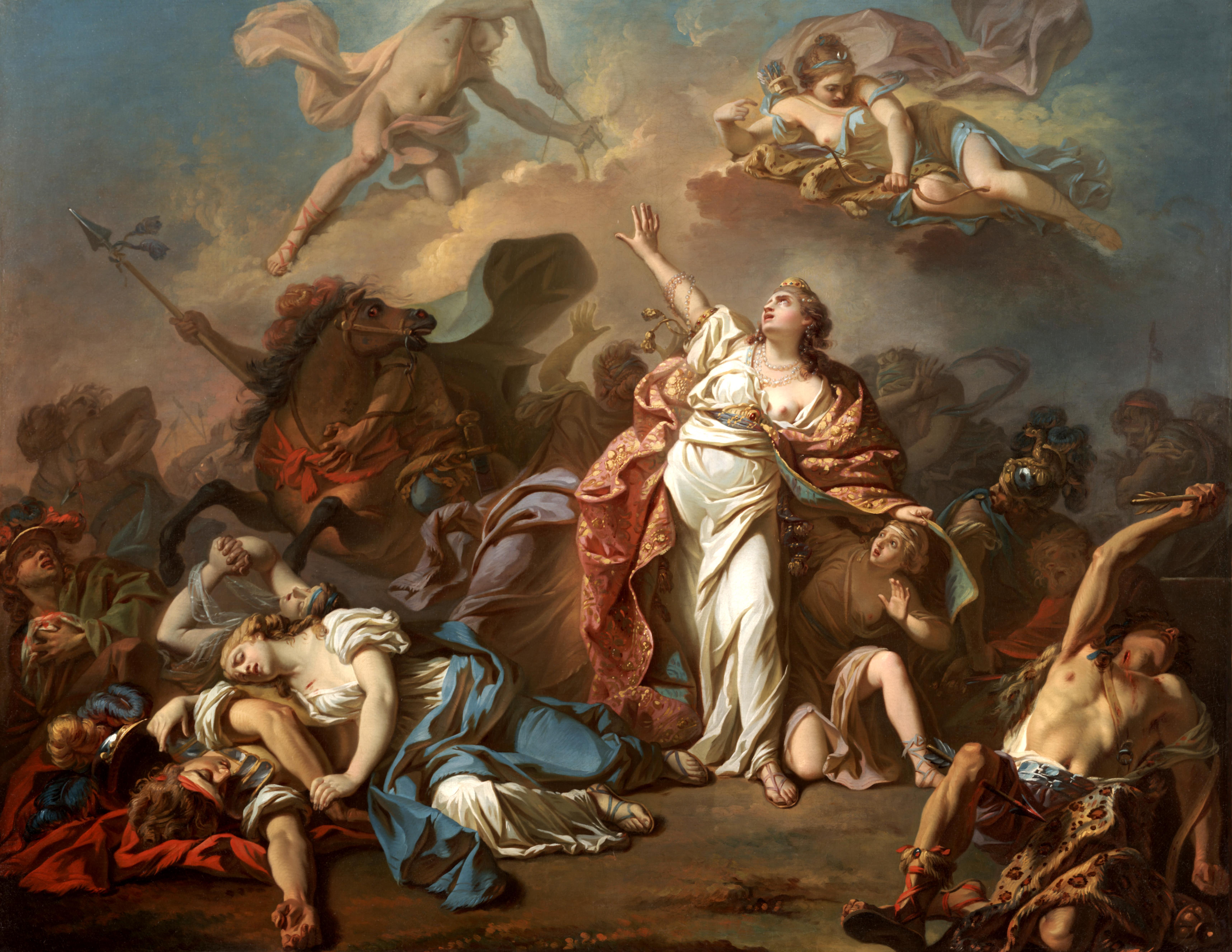
" Apollo and Diana punish Niobe by killing her children ", By Artist Jacques-Louis David ( 1748 – 1825 )


" Apollo and Diana punish Niobe by killing her children " , Jacques-Louis David


The plot of the painting by the French artist is based on the story of Niobe, told in Ovid's Metamorphoses (Canto 6, 146-312).):

Arrogance towards the immortals has never led to good. einsteinerupload of. Niobe boasted to Leto, the mother of Apollo and Artemis, that she had given birth to seven boys and seven daughters, while the goddess had just two. The twins horribly avenged their mother's insult: Apollo murdered Niobe's seven boys with his arrows that strike every time, and his sister, the hunt goddess, slaughtered all her girls. To top it all off, Zeus transformed Niobe into a tear-filled rock in her home country of Lydia.

The tragic death of Niobe's children served as the storyline for Jacques-Louis David's artwork.

Nothing is more devastating to a mother than the death of her children. And what if she is the one to blame for their deaths? Everyone who hears the story of Niobe, the wife of the Theban king Amphion, shudders with fear.


" Apollo and Diana punish Niobe by killing her children " , Jacques-Louis David  1772 Canvas, oil. Size: 120.6×153.7 cm Museum of Art, Dallas

" Apollo and Diana punish Niobe by killing her children " , Jacques-Louis David - 1772 Canvas, oil. Size: 120.6×153.7 cm Museum of Art, Dallas

" Self - portrait " , Marie-Gabrielle Capet ( 1761 - 1818 ) | ArtLiveAndBeauty


Marie Gabrielle Capet " Self-portrait "


In this "Self-portrait," the French neoclassical artist depicts herself sitting in front of an easel. In her right hand is a holder with a crayon. The delicate face of a twenty-two-year-old artist is well depicted. The capet precisely captures the texture of his dress's silk, the satin bow with which his hair is gathered, and the delicacy of the lace.

Marie-Gabrielle Capet (1761-1818) was one of the first female painters to paint professionally and for a livelihood in the 18th century. Adelaide Labille-student. Guillard's Known largely as a portrait painter who specialized in miniatures.

Marie-Gabrielle Capet, together with a teacher and other artists such as Marie Elisabeth Louise Vigée-Lebrun, successfully presented her paintings at the Salon, where there were works by more than twenty women in 1791, for example.


" Self-portrait " , Marie Gabrielle Capet , C. 1783 Canvas, oil. Size: 77.5x59.5 cm Tokyo National Museum of Western Art

" Self-portrait in a hat with a silk bow " , Angelica Kaufman (1741–1807) | ArtLiveAndBeauty


" Self-portrait in a hat with a silk bow " , Angelica Kaufman (1741–1807)


Angelica Kaufman is one of a relatively tiny group of internationally renowned female artists. Even if you've never heard of her before, you're definitely familiar with her work. The Swiss artist has numerous self-portraits; the Hermitage was written by the time she arrived to Rome.


The young exquisite girl in the painting, dressed in a low-cut dress, wearing a hat with a silk bow in the style of the period, and with curls readily spread over her shoulders, is a woman of amazing destiny. Angelica Kaufman, who did not obtain a formal education, rose to prominence by her ability and diligent copying of the works of great artists.


Angelica Kaufman's standing is demonstrated by her election to the Florentine Academy of Arts, the French Royal Academy, the Academy of St. Luke in Rome, and, most notably, the Royal Academy of Arts in London, where she was the only woman. Angelica Kaufman rose to prominence as a portrait painter. The oval form of the canvas and the muted sound of soft pastel hues are typical of a late 18th century portrait. An attentive, intelligent expression and a barely visible grin, just touching the corners of her lips, provide a personal touch to the image, distinguishing it from the Angelica Kaufman's other female portraits.


" Self-portrait in a hat with a silk bow " , Angelica Kaufman ,1770-1780s Oil on canvas, Dimensions: 77 x 63 cm State Hermitage Museum, St. Petersburg