36 Paintings by Wang Yiguang | A Contemporary Chinese Artist | ArtLiveAndBeauty


Wang Yiguang's Paintings


Contemporary fine art is not without manifestations of beauty, even if they are not always visible to the general audience. And the more intriguing it is to look for and discover a wide range of riches inside it. Chinese artist Wang YiGuang produced the paintings). They show Tibet, females, and yaks. Wang Yiguang has always had a passion for art. He was influenced by his older brother Wang Yidong, who was also a well-known artist. Young Wang Yiguang, wanting to follow in his footsteps, enrolls at Beijing's Central Academy of Fine Arts. He learns a lot there and becomes a good painter, even gaining popularity by participating in art shows in China and other countries. His works have been shown in Tokyo, Hong Kong, Guangzhou, and, of course, Beijing.


Artist Fritz Zuber Buhler ( 1822 - 1896 ) - The Master of Elegance and Romance


 Artist Fritz Zuber-Buhler's Paintings


Fritz Zuber-Buhler was a prominent 19th-century Swiss artist whose paintings captured the essence of elegance, beauty, and romance. Born on the 21st of June, 1822, in Le Locle, Switzerland, Zuber-Buhler's artistic talent blossomed at a young age. He received his early education at the Gymnase cantonal in Neuchâtel and then pursued his artistic studies in Paris, under the tutelage of renowned French painter François-Édouard Picot.

Zuber-Buhler's artistic style was deeply influenced by the prevailing Romanticism movement of his time. He excelled in portraying idyllic and sentimental scenes, often depicting beautiful women in luxurious surroundings. His works focused on capturing the delicate play of light, intricate details, and a keen sense of aesthetics, which brought his subjects to life with an enchanting allure.

Throughout his career, Zuber-Buhler gained recognition for his exceptional skills in rendering female figures. His portrayals of women were marked by their grace, refinement, and impeccable fashion. Often depicted in elegant gowns and surrounded by flowers or pastoral landscapes, these women exuded an air of sophistication and timeless beauty.

One of Zuber-Buhler's notable strengths was his ability to convey emotions through the subtle expressions and body language of his subjects. Whether it was the wistful look of a daydreaming lady or the joyous laughter of a playful child, Zuber-Buhler captured these fleeting moments with sensitivity and skill.

Zuber-Buhler's choice of themes ranged from historical and mythological scenes to portraits and genre paintings. His works often incorporated elements of fantasy, further adding to the romantic and dreamlike quality of his art. He skillfully infused his compositions with a sense of narrative, allowing viewers to imagine stories and emotions beyond the canvas.

In addition to his talent as a painter, Zuber-Buhler was also a skilled draftsman and printmaker. His etchings and engravings revealed the same level of attention to detail and artistic finesse seen in his paintings. These prints allowed a broader audience to appreciate his artistry, and many became highly sought after by collectors.

During his lifetime, Fritz Zuber-Buhler received numerous accolades and exhibited his works in prestigious art salons and galleries across Europe. His paintings were well-received, and he gained a considerable following among art enthusiasts and patrons.

Today, Zuber-Buhler's works are treasured as valuable representations of the Romantic era. They continue to inspire artists and art enthusiasts alike, serving as a reminder of the enduring appeal of beauty, emotion, and the power of artistic expression. His legacy as a master of elegance and romance lives on through the admiration of art connoisseurs and the continued influence of his paintings on contemporary artists.

In conclusion, Fritz Zuber-Buhler remains an artist whose impact transcends time. His ability to capture the subtleties of emotion and create mesmerizing compositions ensures his place in art history as a master of Romanticism. Through his depictions of beautiful women and enchanting scenes, he invites us to immerse ourselves in a world of grace and splendor, leaving a lasting impression on all who behold his art.


Anthony Frederick Augustus Sandys ( 1829 - 1904) | A 18th Century Pre-raPhaelite English Painter | ArtLiveAndBeauty


Anthony Frederick Augustus Sandys's Paintings


Anthony Frederick Augustus Sandys, or just Frederick Sandys (May 1, 1829 - June 25, 1904) -On May 1, 1829, in Norija, Norfolk, England, an English painter Pre-Raphaelite, an illustrator and a drawingman who authored mostly portraits, as well as works in the area of mythical painting, was born. His father, who was also an artist, gave him his first drawing lessons. Frederick Sandys, who shown exceptional talent, attended the Noridge designer school (English Norwich School of Design) in 1846 on the recommendation of his father, and rose to prominence owing to his caricature of the Nightnaya Nightmare for John Evetta Mille Sir Izuyumbra in 1857. 


The Oedipus Myth's Paintings | ArtLiveAndBeauty


 The Oedipus myth's Paintings


The tales of Oedipus' misfortune is directly related to his screwed-up father, the Theban monarch Laius, who managed to enrage the gods. Lai once admired a lovely young man who had a blue vein on his forehead when he was younger. Chrysippus was the young man's name, and he was the son of King Pelops, who unwisely housed the future Pope Oedipus. Lai abducted the son of King Chrysippus in return for hospitality, carried him to Thebes, and treacherously raped him. therefore disgracefully treating a young man who is wholly straight (which is already unusual for Greece). It is evident that Pelops could not tolerate Lai's betrayal and cursed him to hell by invoking the wrath of the Greek gods. Later, Lai was crowned king of Thebes and wed the lovely Jocasta, but that was terrible luck. He was unable to leave any heirs. And Chrysippus, who was messed up in his childhood, is at fault.

Years went by. Lai governed Thebes in silence, although he was childless. He once travelled to Delphi to see the oracle on the causes of his infertility and received the advice: "Do not wish yourself a son against the will of the gods. When he is born, you will perish at his hands, his mother will become his wife, and your entire family will be drenched in blood.


When Lai's baby was born, he strapped his legs together, called a slave, and told him to dump the infant into the forest so that wild animals would rip him to pieces. Lai came home with sad heart. The slave seized the infant and brought it into the wilderness, but when his master had ordered him to do otherwise, the slave felt bad for the youngster and decided to take the child to the nearby city of Corinth instead. There, where herds were grazing on the slopes of the mountains, he entrusted the kid to one of the slaves of the Corinthian king Pelops. King Pelops was an empty-nester. After learning of the boy, he made the decision to take him home and nurture him as an heir. He carried out his plan, snatched the boy from the shepherd, and gave him the name Oedipus, which is Greek for "The Man with Swollen Feet," since the boy's legs were tightly bound with a belt and had a large amount of swelling.

Oedipus grew raised in Pelops' palace, thinking of him as his father and having no idea where he came from. The palace once hosted a festive feast when plenty of wine was consumed and the attendees were utterly inebriated. Additionally, Oedipus overheard insulting words: "Foundling! You are not the son of our monarch!" during a drunken argument. Oedipus was grieved by the insult; he inquired of Pelops whether the visitors were saying the truth, but the latter counselled against listening to idle gossip. Oedipus remained agitated. He sought guidance from the oracle. Through the Pythia, Apollo said, "Terrible is your fate, Oedipus! You'll murder your father, wed your mother, and have offspring from your union that the gods have cursed!

After hearing such a dire prophecy, Oedipus made the decision to leave Corinth for good. Without realising it, he followed the first route that he came upon, which goes to Thebes. He guided him into a little gorge. Here, the route was congested, making it hard to disperse. Oedipus almost ran into the chariot a gray-haired, regal-looking elderly guy was riding as he was lost in meditation. The gruff voice of the driver, "Get out of the way, tramp!" could be heard. Don't you see that the route can only support a chariot?
Oedipus had a tendency to lose his anger. The driver's rudeness infuriated him, and he struck him with his staff until he was so badly injured that he collapsed to the ground and died. The chariot's owner and attendant servants charged the young guy, but Oedipus murdered them all with his staff. One slave was the only one to succeed in escaping. Oedipus then continued on his journey. He was unaware that the first portion of the prophesy had been fulfilled: Lai, his father, was the elderly man he killed.

Oedipus finally arrived at Thebes. He arrived to the city in profound despair. The gods not only delivered another attack—a monstrous Sphinx materialised close to the city—but also the king died. It had a female-like head, a lion's body, paws with razor-sharp claws, and enormous wings. The Sphinx gave all tourists a riddle to solve, and if they failed, it flung them from a cliff. No one who attempted to solve the puzzle lived, despite the efforts of many daredevils. Oedipus made the decision to gamble as well. He reasoned, "It is better to die than to live in a faraway country as a rootless exile.

He arrived to the rock home to the Sphinx. "Create a puzzle! I'm all set! "To the beast, he said. If you're so courageous, describe to me what sort of animal has stronger legs as it gets older and walks on four legs in the morning, two in the afternoon, and three at night. Your question is rather easy, Oedipus said with a chuckle. A guy is this. He gently crawls on all fours in the dawn of his life when he is still young and frail; he walks on two legs throughout the day, or in maturity; and in old age, or in the evening of his life, when he is arthritic and in need of assistance, he uses a crutch, which acts as his third leg.
When the Sphinx learned the solution to her riddle, she became desperate and pushed herself down the cliff, breaking her neck in the process. When Oedipus returned to Thebes, the populace crowned him king in honour of his inventiveness. Oedipus began to reign Thebes after taking Queen Jocasta, the deceased Laius's wife, as his wife. Two girls, Antigone and Ismene, and two sons, Eteocles and Polyneices, were among his soon-to-be born offspring. As a result, the second half of the prophecy came true since Oedipus did marry his own mother.

Oedipus was a wise ruler, and the people of Theba loved him. But because of a curse he carried, the gods cursed the city and brought a dreadful illness there. Unburied bodies were left on the city's streets because the Thebans did not have time to bury the deceased. Screams and moans could be heard everywhere.

After the outbreak, Thebes experienced hunger; no crop fields were provided, and a dreadful plague ravaged the cattle. The sacrifices the residents offered to the gods were in vain since they did not respond to their petitions, and the problems only became worse.
The gods will have pity if the people throw away the one who brought this misfortune upon them by his wickedness; make him pay for the spilt blood of Lai. Oedipus then dispatched Creon, the brother of his wife, to Delphi to consult the oracle. Creon returned with this response. How then can you catch the murderer?

So Oedipus called Tiresias, a blind sorcerer, to his home. He had a remarkable talent from the goddess Athena: he could see the past and the future. Tiresias resisted Oedipus' query for a while before ultimately responding, saying: "You yourself, Oedipus, are the criminal you are seeking for! You killed your father without knowing him, and without knowing your mother, you wed her. Oedipus was furiously enraged at Tiresias, labelled him a liar, and threatened to kill him because he thought he had been bought off by enemies.

The soothsayer was chased away by Oedipus, but a dark foreboding crept into his spirit. He was gradually made aware of the horrible reality. The will of fate has been carried out! Oedipus hurried to his palace out of despair, but there he found a fresh sorrow: Jocasta had killed herself because she could not face the horror of what had transpired. Oedipus ceased to desire the sun's brightness, his native Thebes, or offspring. He also ceased to desire life. Inflicting himself with blindness, Oedipus departed Thebes. Only his daughter Antigone was present when he passed away.


Orpheus and Eurydice , By Artist Anselm Feuerbach (1829–1880)


Orpheus and Eurydice
by Anselm Feuerbach 
 1869


Orpheus, the singer, resided in Thrace in northern Greece. He had a tremendous ability for music, and his popularity spread across the Greek nation. Eurydice fell in love with him because of the music. She eventually married him. Their joy, however, was fleeting. She left her spouse and went into the wilderness. A snake curled around her leg and stung her. Eurydice screamed in agony and fright and collapsed on the grass. Orpheus rushed to his wife after hearing her pleading scream from afar. But when he saw the big black wings flashing through the trees, he knew it was Death carrying Eurydice to the underworld.


Orpheus and Eurydice , by Artist Anselm Feuerbach
source : https://sammlung.belvedere.at/objects/735/orpheus-und-eurydike


Orpheus was overcome with sadness. He abandoned everybody and spent days alone trekking through the woods, singing his heart out. And the force of these gloomy melodies was so strong that the trees abandoned their positions and surrounded the singer. Animals emerged from their burrows, birds fled their nests, and stones became closer. Everyone heard his longing for his lover, and Orpheus determined to visit the realm of the dead himself.


Orpheus sailed down the Styx, passing unknown people's spirits and souls. When he played his lyre, he melted Hades' heart. Orpheus was instructed by Hades that he might take Eurydice with him on one condition: she would accompany him out of the underworld's cave, but he should not look at her before she left the realm of the dead, or he would lose her forever.


Orpheus was overjoyed, thinking it would be a simple chore for someone as patient as himself; he thanked the gods and returned to the world. However, after failing to hear Eurydice's steps, he began to suspect that the gods had duped him. Eurydice was truly behind him, but like a shadow, she needed to return to the light in order to reclaim her complete femininity. Orpheus lost hope only a few feet from the exit and turned to see Eurydice behind him, but her shadow was hurled back into the realm of the dead, now forever.


Orpheus attempted to return to Hades, but a person cannot enter Hades twice while still alive. According to many versions of the tale, Orpheus started to sing a mournful song to his lyre, pleading for death so that he may eternally be with Eurydice. He is eventually slain by the animals that rip him apart. Another account has Zeus striking him with lightning because he was afraid Orpheus would divulge the mysteries of the underworld to the humans.

Alejandro Decinti | A Contemporary Chilean-Spanish Artist | ArtLiveAndBeauty


Alejandro Decinti's Paintings


Alejandro Decinti is a Chilean-Spanish artist who was born in 1973 and attended the University of Chile, finishing with a degree in fine arts. Dictatorship permeated his boyhood, so it's no surprise that one of his shows is titled "Little America," after Pablo Neruda's poem. His art, like Neruda's poetry, is comprised of the contrasts prevalent in his nation at the time. Since 2002, and till today, the artist has lived and worked in Spain, near Madrid.


Poetess By Artist Fritz Zuber Buhler 1822 - 1896


" Poetess " , By Artist Fritz Zuber-Buhler


 A well-known painting by the Swiss artist, whose work is notable for its romantic subjects, detailed compositions and elegant painting style. The Poetess was painted at the end of the 19th century, when the movements of feminists and suffragettes fighting for equality between men and women were just beginning to develop in Europe. Perhaps the main character was one of those women.

 What should a respectable mother of a family think about? Probably about the fact that the children were healthy, well-fed and that the husband was happy and did not leave for another. But not in this case. The heroine of the painting by Fritz Zuber-Buhler became interested in poetry. The woman is so passionate about writing another masterpiece that she cannot pay attention to the household. Therefore, things in the family are not going as well as we would like.

 A coffee pot with a cup, saying that the poetess sat at work all night. However, the muse never came to the woman, which can be understood from the pile of drafts lying under the table. The troubles of life are of little concern to the main character, who is in her own creative world, where, judging by the slight smirk on her face, she feels good.

 Fritz Zuber-Bühler ( 1822 - 1896 ) was a Swiss genre painter. Born in Le Locle, Switzerland. At the age of 16 he moved to Paris, where he met his first teacher, Louis Groscloud (1784-1869). Then he studied at the School of Fine Arts, improved his skills with Francois-Edouard Picot. Then he went to Italy, after 5 years he returned to Paris and there, in 1850, he made his debut at the Salon.


" Poetess " , Fritz Zuber-Buhler, 1880 Canvas, oil. Size: 68x76 cm. Bern Art Museum
" Poetess " , Fritz Zuber-Buhler, 1880 Canvas, oil. Size: 68x76 cm. Bern Art Museum 


" Venus Rises from the sea " c.1822 by American Artist Raphael Peel ( 1774 - 1825 ) | ArtLiveAndBeauty


"Venus Rises from the sea" by Artist Raphael Peel


A painting by Raphael Peel stands out among the classics on display at the Nelson-Atkins Museum of Art. "Venus emerging from the sea" - this trompe-l'oeil canvas on a mythical storyline is created using the trompe-l'oeil technique. This was the name given to the fraudulent paintings in which the artists produced the appearance of object realism. The white veil pictured on the artwork is authentic.

In this weird manner, the American Raphael Peel, who worked in the first half of the nineteenth century, attempted to fathom the old topic of the artist's abilities.

According to folklore, one creator (Zeukis) was able to design a bunch of grapes so realistically that the birds sat down to nibble at the fruit, mistaking it for a genuine one. Another (Parrhasius) misled Zeukis himself by depicting a curtain torn to rags ostensibly obscuring the painting. The romantic here also plays on the hypocrisy of his contemporaries, who desire to conceal a person's trembling naked body with a veil of morality (white color traditionally meant innocence).

Artist Raphael Peel (1774 - 1825 ) is regarded as America's first outstanding still-life painter. Charles Wilson Peel was the son of painter Charles Wilson Peel. Raphael is one of 16 children in a painter's family, all of whom were named after famous painters.


"Venus Rises from the sea" by Artist Raphael Peel, c.1822 Canvas, oil. Size: 74x61.3 cm. Nelson-Atkins Museum of Art, Kansas, USA

" The Ghost of Clytemnestra Awakening the Furies " , By Artist John Downman (1750 - 1824)


" The Ghost of Clytemnestra Awakening the Furies " ,  John Downman


John Downman (1750 - 1824) - Welshportrait painter, who also painted genre paintings on historical themes. " The Ghost of Clytemnestra Awakening the Furies " is one such work.


In Greek mythology, Clytemnestra was the daughter of Tyndareus and Leda the Swan, the king and queen of Sparta, according to Greek mythology. She was half-sister of Helen. King of Mycenae Agamemnon and Clytemnestra had a son named Orestes as one of their offspring. Menelaus, who wed Helen, regarded as the most beautiful lady in the world, had an older brother named Agamemnon.


Agamemnon and his brother Menelaus travelled to Troy to battle for Helen's return after she was abducted and transported there. Aegisthus, the husband's cousin, was Clytemnestra's lover when she got home, and the two of them conspired to kill Agamemnon. Clytemnestra trapped Agamemnon in a net in the bathroom when he came back, and Aegisthus murdered him with a double-edged axe.


" The Ghost of Clytemnestra Awakening the Furies " , John Downman  1781 Oil on canvas. Size: 51×65 cm. Yale Center for British Art, Paul Mellon Collection, New Haven

 " The Ghost of Clytemnestra Awakening the Furies " , John Downman, 1781 Oil on canvas. Size: 51×65 cm. Yale Center for British Art, Paul Mellon Collection, New Haven


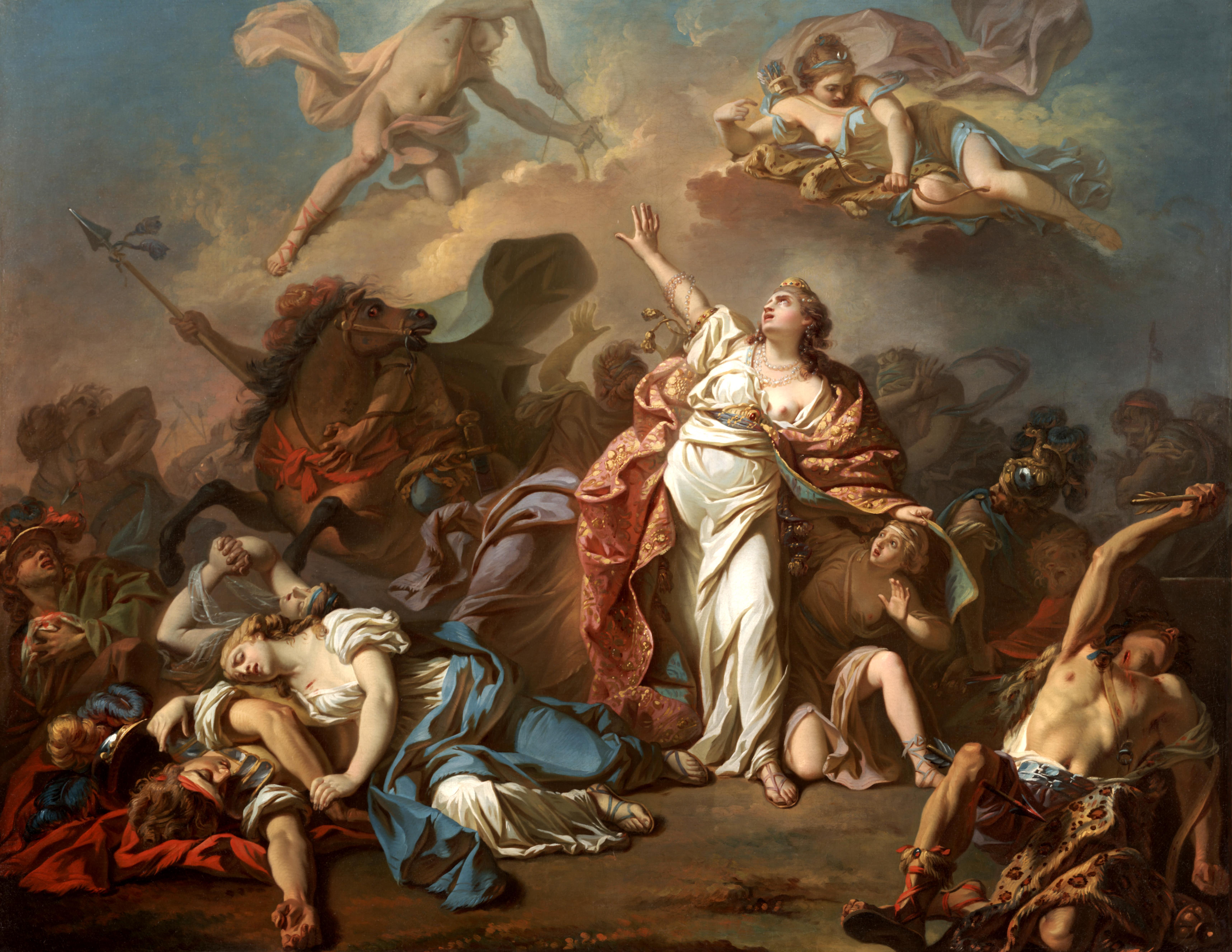
" Apollo and Diana punish Niobe by killing her children ", By Artist Jacques-Louis David ( 1748 – 1825 )


" Apollo and Diana punish Niobe by killing her children " , Jacques-Louis David


The plot of the painting by the French artist is based on the story of Niobe, told in Ovid's Metamorphoses (Canto 6, 146-312).):

Arrogance towards the immortals has never led to good. einsteinerupload of. Niobe boasted to Leto, the mother of Apollo and Artemis, that she had given birth to seven boys and seven daughters, while the goddess had just two. The twins horribly avenged their mother's insult: Apollo murdered Niobe's seven boys with his arrows that strike every time, and his sister, the hunt goddess, slaughtered all her girls. To top it all off, Zeus transformed Niobe into a tear-filled rock in her home country of Lydia.

The tragic death of Niobe's children served as the storyline for Jacques-Louis David's artwork.

Nothing is more devastating to a mother than the death of her children. And what if she is the one to blame for their deaths? Everyone who hears the story of Niobe, the wife of the Theban king Amphion, shudders with fear.


" Apollo and Diana punish Niobe by killing her children " , Jacques-Louis David  1772 Canvas, oil. Size: 120.6×153.7 cm Museum of Art, Dallas

" Apollo and Diana punish Niobe by killing her children " , Jacques-Louis David - 1772 Canvas, oil. Size: 120.6×153.7 cm Museum of Art, Dallas